
Journals102
Newest
Welcome to the Internet. Now go home.
6 min read
I post stuff here, on fetlife, and on tumblr. Well, I used to - now I hardly do at all.
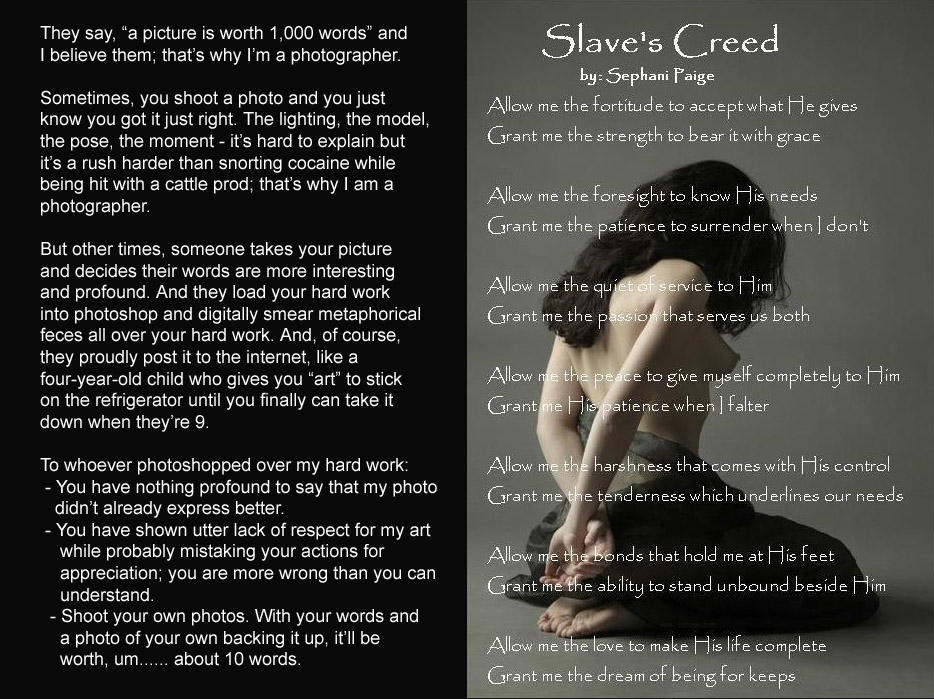
Not because of copyright. I understand that when you post something on the internet, you're posting it for everyone to look at, and it's going to get shared around. But the comped-up piece of shit you see above (minus my commentary) is all over the internet - it's far more widely distributed than my original version. Back when I used to read my messages here and on Fetlife, I had 12-20 messages per day about stuff like this. Mostly it was people trying to be helpful and telling me "HEY! Look over here, there's another person who smeared shit all over your art!" And it used to take me an hour every morning to cut and paste URLs into DMCA requests to get this kind of crap taken down.

But that's really only the tip of the emotional iceberg for me. About 1 in 10 times that I post a DMCA I'd get a message from the person who had posted it. So not only would my inbox be filled with woe from all the copyright violations, I'd get a breakdown approximately as follows:
10% You #*!@&^!ing @#*&!@! I hope your !&*!&^# falls off and you die of cancer!!!
30% By posting an image on the internet it's in the public domain (followed by 3 pages of complete wrongness about copyright)
30% You can't make me stop! Nyaa nyaa nyaa fuck you nyaa nyaa!
20% A lecture about how mean and rude I am
5% A genuine apology
5% Well, I like it anyway, so in spite of your having complained to me and explained why you don't like it, is it OK if I keep it up? (completely clueless in other words)
Understand, as I do, that that's a small percentage of a small percentage of all the people who share my images around. But with the size of the population on the internet, it's a large number in total. On a site like Fetlife, that equates to about 100 threatening or angry emails a year. Yeah, it really makes me feel appreciated.
I set that against the times when someone comes up to me at a conference and says "dude, I love your photography!" or I get an email from someone asking please please please for a high resolution version of the file because they want to make a big print of it and frame it for their sweetie. Or, the occasional emails where someone thanks me for my stock photography helping them get a cover gig for their first book cover. Those are great. I love those moments. But they sure as hell aren't as often as the angry, petulant, bratty, or downright snotty lectures I get from ignoramuses who want to hide behind their personal interpretation of copyright law (which, by the way, is universally wrong) or who are incapable of saying "I'm sorry."
Let me tell you a true story: one of the better online friends I made on Deviantart is someone I got to know because they ripped off one of my artworks and photoshopped on it (brilliantly) to turn it into a photocomposite. I told them they couldn't do that, and they said they loved my stuff, and I suggested they use a different image - here - ... and we were off to the races. We've been swapping ideas and I've been shooting custom stock for them ever since; It's a positive and nurturing creative collaboration.
You see, I'm not some ogre. I want to get my art on just like you. But I am increasingly feeling backed into a corner. I got into doing the wet plates because a) it's cool b) I get to work with nasty dangerous stuff c) it looks awesome d) you cannot duplicate a plate; it's a unique artwork. I started doing wet plates in order to protect myself emotionally and to protect my art. Oh, want to know how that turned out? Some cheese-brain was taking the scans I post of my wet plates and removing my art from them, so he could use the edges in his images because, yeah, they look cool!! He. Threw. My. Art. Away. Because. The. Only. Part. That. Was. Useable. Was. The. Edges. I almost offered him a wet plate so I could get his address and go talk to him about it face to face.
These are the emotional trade-offs I'm up against. I've finally had to confront the fact that if I want to keep posting stuff on the internet, I'm going to have to utterly concede to the faceless horde out there. I will have to either stop altogether or give it all away. Not just give it away technically, give it away emotionally. And that's the problem: if I don't care, it's not going to be any good.

If I didn't give a shit how my photography looked, I wouldn't give a shit about someone photoshopping their bad high school poetry over top of it. I wouldn't argue with them. I'd just have to lie there and take it, and I know that eventually it's going to mean creative death for me. Perhaps where I am headed is toward making photos just for myself, and not sharing them with anyone. That's sort of where I am, already. I have boxes and boxes of wet plates on a shelf over at my studio. There, they sit. I have tens of thousands of digital images on my hard drive(s). There, they sit. I am frozen at the perfect apex between anger, disgust, and the desire to quit.
Not because of copyright. I understand that when you post something on the internet, you're posting it for everyone to look at, and it's going to get shared around. But the comped-up piece of shit you see above (minus my commentary) is all over the internet - it's far more widely distributed than my original version. Back when I used to read my messages here and on Fetlife, I had 12-20 messages per day about stuff like this. Mostly it was people trying to be helpful and telling me "HEY! Look over here, there's another person who smeared shit all over your art!" And it used to take me an hour every morning to cut and paste URLs into DMCA requests to get this kind of crap taken down.
But that's really only the tip of the emotional iceberg for me. About 1 in 10 times that I post a DMCA I'd get a message from the person who had posted it. So not only would my inbox be filled with woe from all the copyright violations, I'd get a breakdown approximately as follows:
10% You #*!@&^!ing @#*&!@! I hope your !&*!&^# falls off and you die of cancer!!!
30% By posting an image on the internet it's in the public domain (followed by 3 pages of complete wrongness about copyright)
30% You can't make me stop! Nyaa nyaa nyaa fuck you nyaa nyaa!
20% A lecture about how mean and rude I am
5% A genuine apology
5% Well, I like it anyway, so in spite of your having complained to me and explained why you don't like it, is it OK if I keep it up? (completely clueless in other words)
Understand, as I do, that that's a small percentage of a small percentage of all the people who share my images around. But with the size of the population on the internet, it's a large number in total. On a site like Fetlife, that equates to about 100 threatening or angry emails a year. Yeah, it really makes me feel appreciated.
I set that against the times when someone comes up to me at a conference and says "dude, I love your photography!" or I get an email from someone asking please please please for a high resolution version of the file because they want to make a big print of it and frame it for their sweetie. Or, the occasional emails where someone thanks me for my stock photography helping them get a cover gig for their first book cover. Those are great. I love those moments. But they sure as hell aren't as often as the angry, petulant, bratty, or downright snotty lectures I get from ignoramuses who want to hide behind their personal interpretation of copyright law (which, by the way, is universally wrong) or who are incapable of saying "I'm sorry."
Let me tell you a true story: one of the better online friends I made on Deviantart is someone I got to know because they ripped off one of my artworks and photoshopped on it (brilliantly) to turn it into a photocomposite. I told them they couldn't do that, and they said they loved my stuff, and I suggested they use a different image - here - ... and we were off to the races. We've been swapping ideas and I've been shooting custom stock for them ever since; It's a positive and nurturing creative collaboration.
You see, I'm not some ogre. I want to get my art on just like you. But I am increasingly feeling backed into a corner. I got into doing the wet plates because a) it's cool b) I get to work with nasty dangerous stuff c) it looks awesome d) you cannot duplicate a plate; it's a unique artwork. I started doing wet plates in order to protect myself emotionally and to protect my art. Oh, want to know how that turned out? Some cheese-brain was taking the scans I post of my wet plates and removing my art from them, so he could use the edges in his images because, yeah, they look cool!! He. Threw. My. Art. Away. Because. The. Only. Part. That. Was. Useable. Was. The. Edges. I almost offered him a wet plate so I could get his address and go talk to him about it face to face.
These are the emotional trade-offs I'm up against. I've finally had to confront the fact that if I want to keep posting stuff on the internet, I'm going to have to utterly concede to the faceless horde out there. I will have to either stop altogether or give it all away. Not just give it away technically, give it away emotionally. And that's the problem: if I don't care, it's not going to be any good.
If I didn't give a shit how my photography looked, I wouldn't give a shit about someone photoshopping their bad high school poetry over top of it. I wouldn't argue with them. I'd just have to lie there and take it, and I know that eventually it's going to mean creative death for me. Perhaps where I am headed is toward making photos just for myself, and not sharing them with anyone. That's sort of where I am, already. I have boxes and boxes of wet plates on a shelf over at my studio. There, they sit. I have tens of thousands of digital images on my hard drive(s). There, they sit. I am frozen at the perfect apex between anger, disgust, and the desire to quit.
Join the community to add your comment. Already a deviant? Log In
The Dining Philosophers - a Problem
9 min read
Epicurus muttered, "None of this affects me at all," excused himself, and slipped out the back door practically unnoticed. That left the table unbalanced. On one side were the ancient worlders: Plato and Aristotle, heads together in deep discussion, and Socrates, who appeared to be gently questioning Miletus while Sextus Empiricus studiously withheld judgement on the proceedings.The opposite end of the table was mostly held by the enlightenment gang, with Lao-Tze as the sole outlier, holding down the farthest end of the table as he watched the proceedings, imperturbably. Voltaire had given up on his hopes of getting Lao-Tze to appreciate his witticisms, and shifted his focus to Rousseau, who was trying to hide behind the equally imperturbable bulk of David Hume. Neitzsche was berating Hume, loudly, and making wickedly poetic assertions that made Spinoza occasionally put his head down and "facepalm" though he quickly converted the gesture to what appeared to be a thoughtful forehead-rub. Lao-Tze caught his eye on one of these occasions and his face lit with a brief smile of utter joy, which Spinoza found himself sharing.
In the center of the table, of course, was the guest of honor's seat. When Jesus arrived and sat down, quietly, you could hear a pin drop. The assembled lovers of wisdom stopped what they were doing, Voltaire with his hand raised and crooked, frozen in the middle of an elegantly airy gesture, and Hume with a very fine piece of smoked fish halfway to his mouth. Sextus Empiricus raised a sardonic eyebrow, as The Nazarene made a gesture encompassing them all, "I greet you!" he said.
The silence in the room would make your ears ring, until Socrates stood and asked gently, "Whence, therefore, Evil?" Neitzsche blew his breath out through his mustache and sat back, "ah!" and Lao-Tze's smile became more joyful, if such a thing was possible, still. Everyone in the room waited for The Nazarene's reply.
My mind does strange things when I'm flying a red-eye coast-to-coast and have had a couple glasses of red wine prior to boarding. I'd been discussing religion with a fellow I'd met recently and one of the things he'd said the day before was that "Jesus was a great philosopher." I know I cringed visibly when I heard that, but at the time I was playing nice so I didn't say anything. Perhaps you've heard similar things about the "great philosophy" in the bible (or, for that matter, the koran, book of mormon, or much of the buddhist literature) The reason that assertion is so cringe-worthy is because those books contain virtually nothing resembling a coherent philosophy, and none of the characters in those books are remotely anything like philosophers. In the case of Jesus, he was a god-man – supposedly part of the supernatural forces that give man morality and free will through assertion (if you're a christian who accepts divine command theory) I was thinking that none of the real philosophers I've read say "Because I said so" and mistook that for a philosophical argument.
If the son of god were a philosopher, and showed up on earth in a form whereby he could be questioned by humans, he'd immediately barraged with important and interesting questions. Not the little piffle like "hey, check out this adulterer we're going to stone, derp, derp!" or "can you turn this water into some more wine? Perhaps a good Zinfandel?" but, as Socrates would ask, "Whence, therefore, Evil?"
Think about it. If you're a philosopher and suddenly found yourself face to face with a real honest to goodness supreme being, you would not ask it whether it wore boxer shorts or briefs. There are so, so many questions that a real philosopher would immediately ask! In my little fantasy scenario above, I imagine that Jesus would have had a pretty hot and sweaty time once Voltaire started backing up Socrates' questions, and with Plato and Aristotle standing by to check his logic, "because I said so" wouldn't get him very far at all. I assembled my cast of characters carefully, because:
- Socrates would be absolutely fearless in being willing to question a god. He died, apparently quite graciously, because he loved philosophy and did not fear what earthly powers could do to his body. He would not hesitate for a moment to annoy the living fuck out of a god, just as he annoyed so many of the politicians and thinkers of great Athens.
- Plato would no doubt wish to resume the question he voiced through Socrates in my favorite of his dialogs, the Euthyphro, namely, "Is there a piety that the gods love, or is something pious simply because it is loved by the gods?" A real philosopher would not let Jesus stand there without explaining whether he was the source of all morals or whether he adhered to a set of higher morals himself – and, if so, where those morals came from.
- Aristotle would ask Jesus, in his role as god, "where did god come from?" The great systematizer of philosophy would not allow such an important question to hang.
- Thales would doubtless have some questions about the nature and origin of the universe.
- Sextus Empiricus (assisted ably by David Hume) would confuse Jesus unbearably by querying his epistemology: if god is the source of all knowledge, how did god come to know? I am sure that they would do it gracefully – perhaps as a tag team – but Jesus would quickly find himself in an infinite regress (pyrrhonian trope #2) as he attempted to certify his criteria without being dogmatic. I imagine that Hume would watch Sextus at work, while mentally composing a brilliant essay on "Is god naturally dogmatic?" Many of the christian apologists I've encountered have claimed that god is the anchor for all claims of knowledge. "Well, how do you know that?" I wish I could watch Sextus Empiricus and David Hume work that particular topic.
- Lao-Tze and Epicurus both recognized in their philosophies that the actions of the gods are more or less irrelevant to the affairs of men, and that wise men should act accordingly. After all, if the gods chose to serve you as they did Job, then you're going to get fucked and there's nothing you can do about it. Conversely, if they're going to raise you high and make you mighty, you're hardly in a position to take credit for it. I imagine that Epicurus and Lao-Tze would wind up in the garden, enjoying the stars and the breeze. Of all the conversations in philosophy that I would want to hear, it would be this one.
- Spinoza would eventually join Lao-Tze and Epicurus in the garden.
- Nietzsche would be a potentially delightful interlocutor for Jesus, who could ask him, "so, do I appear dead to you?" "Not until tomorrow," would be Nietzsche's snappiest come-back, though it would be way too brief for him.
- Rousseau would doubtless have some questions for a god, regarding the origin of its authority. If this were a Monty Python sketch, I could see Rousseau asking Jesus, "Supreme authority comes from a mandate from the masses, not from mere supreme power!" ("Come and see the violence inherent in the system! Help! Help! I'm being repressed!")
- Voltaire would provide a witty, clear, and devastatingly arch summary of the discussion.
I'm also sure that Jesus' disciples were not philosophers. Indeed, you've got to wonder "what's wrong with those guys?" Here they were following around god, and didn't think to ask him any interesting questions? Or, if they did, they didn't take notes. Like the time Matthew was busy re-tying his sandal during the sermon on the mount and missed the part where Jesus said, "By the way, load up on Cisco on its IPO. Stay away from Facebook, it'll tank." Joking aside, you'd think that, as Aristotle almost certainly would have, one of Jesus' disciples would have asked him, "what causes people to sometimes get sick when nobody around them does?" and Jesus could have told the great systematizer about bacteria and viruses. Perhaps, you'd think Jesus would have mentioned en passant to Matthew, "by the way, Matt, Earth goes around the Sun, not the other way around. Write that down in your testament and people'll respect you for actually knowing something."
No, Jesus wasn't a philosopher. Nor were any of his disciples. If you think about it, if Jesus really was god come-to-Earth, he did the most piss-poor performance possible. It could have only been worse if he'd worn a gag arrow-through-the-head hat and played banjo. "Oh, I'm not here to actually talk philosophy or teach, I'm just here to be bloodily slaughtered. And Mel Gibson's going to make $100mil on a movie about it. W00T!"
And people wonder why we atheists laugh at religions.
-
Addendum: Note that today's philosophers actually do have a chance to question gods. For one thing, there's good old Tenzin Gyatso, that wretched platitude-spouting conman who allegedly is a multi-incarnated partially supernatural being of supreme wisdom. You'd think that he could explain the problem of evil, or perhaps refute Sextus Empiricus in detail. But, instead, he's concerned with heavy issues like whether oral sex is "sexual misconduct" or whether homosexuals should have human rights. As an armchair philosopher, I am disgusted by the intellectual slack that this cheese-brained theocrat gets granted. Why hasn't someone asked him (as Sextus Empiricus would) "How do you know that you've lived before?" Another diety among us is the Emperor Of Japan. I don't think he makes any specific claims to specialness other than direct descent from goddess amaterasu. But for a divine being, his grasp of geopolitics and warfare are about as good as the dalai lama's grasp of quantum mechanics. For that matter, someone could ask the pope Socrates' question to Euthyphro. I'm sure his little toesie-woesies would curl helplessly in his silk prada slippers, and he wouldn't have an answer. This is a guy who claims divine knowledge regarding who should stick their penis into whom, but doesn't want to tackle the really interesting questions that philosophers grapple with all the time. Whence, therefore Evil? Indeed!
In the center of the table, of course, was the guest of honor's seat. When Jesus arrived and sat down, quietly, you could hear a pin drop. The assembled lovers of wisdom stopped what they were doing, Voltaire with his hand raised and crooked, frozen in the middle of an elegantly airy gesture, and Hume with a very fine piece of smoked fish halfway to his mouth. Sextus Empiricus raised a sardonic eyebrow, as The Nazarene made a gesture encompassing them all, "I greet you!" he said.
The silence in the room would make your ears ring, until Socrates stood and asked gently, "Whence, therefore, Evil?" Neitzsche blew his breath out through his mustache and sat back, "ah!" and Lao-Tze's smile became more joyful, if such a thing was possible, still. Everyone in the room waited for The Nazarene's reply.
My mind does strange things when I'm flying a red-eye coast-to-coast and have had a couple glasses of red wine prior to boarding. I'd been discussing religion with a fellow I'd met recently and one of the things he'd said the day before was that "Jesus was a great philosopher." I know I cringed visibly when I heard that, but at the time I was playing nice so I didn't say anything. Perhaps you've heard similar things about the "great philosophy" in the bible (or, for that matter, the koran, book of mormon, or much of the buddhist literature) The reason that assertion is so cringe-worthy is because those books contain virtually nothing resembling a coherent philosophy, and none of the characters in those books are remotely anything like philosophers. In the case of Jesus, he was a god-man – supposedly part of the supernatural forces that give man morality and free will through assertion (if you're a christian who accepts divine command theory) I was thinking that none of the real philosophers I've read say "Because I said so" and mistook that for a philosophical argument.
If the son of god were a philosopher, and showed up on earth in a form whereby he could be questioned by humans, he'd immediately barraged with important and interesting questions. Not the little piffle like "hey, check out this adulterer we're going to stone, derp, derp!" or "can you turn this water into some more wine? Perhaps a good Zinfandel?" but, as Socrates would ask, "Whence, therefore, Evil?"
Think about it. If you're a philosopher and suddenly found yourself face to face with a real honest to goodness supreme being, you would not ask it whether it wore boxer shorts or briefs. There are so, so many questions that a real philosopher would immediately ask! In my little fantasy scenario above, I imagine that Jesus would have had a pretty hot and sweaty time once Voltaire started backing up Socrates' questions, and with Plato and Aristotle standing by to check his logic, "because I said so" wouldn't get him very far at all. I assembled my cast of characters carefully, because:
- Socrates would be absolutely fearless in being willing to question a god. He died, apparently quite graciously, because he loved philosophy and did not fear what earthly powers could do to his body. He would not hesitate for a moment to annoy the living fuck out of a god, just as he annoyed so many of the politicians and thinkers of great Athens.
- Plato would no doubt wish to resume the question he voiced through Socrates in my favorite of his dialogs, the Euthyphro, namely, "Is there a piety that the gods love, or is something pious simply because it is loved by the gods?" A real philosopher would not let Jesus stand there without explaining whether he was the source of all morals or whether he adhered to a set of higher morals himself – and, if so, where those morals came from.
- Aristotle would ask Jesus, in his role as god, "where did god come from?" The great systematizer of philosophy would not allow such an important question to hang.
- Thales would doubtless have some questions about the nature and origin of the universe.
- Sextus Empiricus (assisted ably by David Hume) would confuse Jesus unbearably by querying his epistemology: if god is the source of all knowledge, how did god come to know? I am sure that they would do it gracefully – perhaps as a tag team – but Jesus would quickly find himself in an infinite regress (pyrrhonian trope #2) as he attempted to certify his criteria without being dogmatic. I imagine that Hume would watch Sextus at work, while mentally composing a brilliant essay on "Is god naturally dogmatic?" Many of the christian apologists I've encountered have claimed that god is the anchor for all claims of knowledge. "Well, how do you know that?" I wish I could watch Sextus Empiricus and David Hume work that particular topic.
- Lao-Tze and Epicurus both recognized in their philosophies that the actions of the gods are more or less irrelevant to the affairs of men, and that wise men should act accordingly. After all, if the gods chose to serve you as they did Job, then you're going to get fucked and there's nothing you can do about it. Conversely, if they're going to raise you high and make you mighty, you're hardly in a position to take credit for it. I imagine that Epicurus and Lao-Tze would wind up in the garden, enjoying the stars and the breeze. Of all the conversations in philosophy that I would want to hear, it would be this one.
- Spinoza would eventually join Lao-Tze and Epicurus in the garden.
- Nietzsche would be a potentially delightful interlocutor for Jesus, who could ask him, "so, do I appear dead to you?" "Not until tomorrow," would be Nietzsche's snappiest come-back, though it would be way too brief for him.
- Rousseau would doubtless have some questions for a god, regarding the origin of its authority. If this were a Monty Python sketch, I could see Rousseau asking Jesus, "Supreme authority comes from a mandate from the masses, not from mere supreme power!" ("Come and see the violence inherent in the system! Help! Help! I'm being repressed!")
- Voltaire would provide a witty, clear, and devastatingly arch summary of the discussion.
I'm also sure that Jesus' disciples were not philosophers. Indeed, you've got to wonder "what's wrong with those guys?" Here they were following around god, and didn't think to ask him any interesting questions? Or, if they did, they didn't take notes. Like the time Matthew was busy re-tying his sandal during the sermon on the mount and missed the part where Jesus said, "By the way, load up on Cisco on its IPO. Stay away from Facebook, it'll tank." Joking aside, you'd think that, as Aristotle almost certainly would have, one of Jesus' disciples would have asked him, "what causes people to sometimes get sick when nobody around them does?" and Jesus could have told the great systematizer about bacteria and viruses. Perhaps, you'd think Jesus would have mentioned en passant to Matthew, "by the way, Matt, Earth goes around the Sun, not the other way around. Write that down in your testament and people'll respect you for actually knowing something."
No, Jesus wasn't a philosopher. Nor were any of his disciples. If you think about it, if Jesus really was god come-to-Earth, he did the most piss-poor performance possible. It could have only been worse if he'd worn a gag arrow-through-the-head hat and played banjo. "Oh, I'm not here to actually talk philosophy or teach, I'm just here to be bloodily slaughtered. And Mel Gibson's going to make $100mil on a movie about it. W00T!"
And people wonder why we atheists laugh at religions.
-
Addendum: Note that today's philosophers actually do have a chance to question gods. For one thing, there's good old Tenzin Gyatso, that wretched platitude-spouting conman who allegedly is a multi-incarnated partially supernatural being of supreme wisdom. You'd think that he could explain the problem of evil, or perhaps refute Sextus Empiricus in detail. But, instead, he's concerned with heavy issues like whether oral sex is "sexual misconduct" or whether homosexuals should have human rights. As an armchair philosopher, I am disgusted by the intellectual slack that this cheese-brained theocrat gets granted. Why hasn't someone asked him (as Sextus Empiricus would) "How do you know that you've lived before?" Another diety among us is the Emperor Of Japan. I don't think he makes any specific claims to specialness other than direct descent from goddess amaterasu. But for a divine being, his grasp of geopolitics and warfare are about as good as the dalai lama's grasp of quantum mechanics. For that matter, someone could ask the pope Socrates' question to Euthyphro. I'm sure his little toesie-woesies would curl helplessly in his silk prada slippers, and he wouldn't have an answer. This is a guy who claims divine knowledge regarding who should stick their penis into whom, but doesn't want to tackle the really interesting questions that philosophers grapple with all the time. Whence, therefore Evil? Indeed!
Join the community to add your comment. Already a deviant? Log In
One Reason...
5 min read
.... why I try not to comment about people's weight.
I used to attend a particular conference on an annual basis, and so I got to (casually) know the other "regulars" who also used to be there. Every year, more or less, I'd see the same group of people at the speakers' dinner, and we could catch up on the usual "what are you up to these days?" kind of stuff. One of the guys I used to see fairly often was a tall heavy-set fellow (some might call him "fat" or "obese") he'd always been tall, bearded, and big, to me. But one year, he showed up and he had lost a lot of weight. It took me a second to recognize him, and I said, "Hey, Rich! You look great! You've lost a lot of weight!" and he looked at me and deadpanned, "Yeah, pancreatic cancer will do that."
Do I need to belabor the point? I will. First off, I set myself up for a massive head-fuck, by making assumptions about what was going on in someone else's life, and - even though I was being friendly about it - I was horribly wrong. He later mentioned that he wouldn't have replied the way he did if there had been anyone else standing around, because then it would have been potentially publicly embarrassing for me. He'd known me for years and knew I had a pretty "take no prisoners" attitude, and thought he'd reply the way he did, just to see how I reacted.
In fact, I responded, "I'm sorry; that was terribly rude of me, wasn't it?"
I mention all of this because I recently posted a few shots which (predictably) garnered a few comments about the model's weight and appearance.

And, as usual, I had to issue a few gentle slappings.
Here's another photo of mine:

Someone who reads the caption under the photo might make the mistake of thinking I was referring to the model's weight. Actually, it's got nothing to do with that - it has to do with some other things the model told me about her health and some other body-related stuff. I was impressed by her even coming out to pose for me, all things considered.
I'm constantly fascinated by how the internet era has encouraged people to leap to all kinds of assumptions about other people, and to jam their feet into their own mouths on a regular basis. Sometimes when they're called on it, they apologize, but often they retreat into postmodernism by claiming it's "merely" a matter of opinion. I've said all I need to say about that, here:

It seems to me that secular humanist notions of "morality" rely on positive arguments for why people should do the "right" thing but ignore far too much the social value of retaliation. The internet, in a sense, is a great big experiment in what kind of society you wind up with when there is virtually no chance that someone you annoy can bring that annoyance back home to you. That, by the way, is one of the reasons I am pretty careful to always "internet" in my true name, and publish my home address and GPS coordinates - for those who have JDAMs - so that I cannot be accused of running away from my own words. If I ever offend someone so much that they want to show up on my doorstep, I'll deal with the consequences at that time. I used to wonder if the people who made derisive or rude comments about some of the models in my photos would deal with it if the model's husband/boyfriend/girlfriend were to call them to account for their words. I admit there are times I think "I'd pay for tickets to see that."
I don't like to lie to make someone feel bad. (Usually the truth serves better!) But I wonder what kind of reactions I'd have gotten on some of the comments about Jenna's body if I had replied, "she looks that way because she's undergoing chemotherapy and wanted to do one final photo-shoot before she dies!" After my gaffe with Rich I'm a lot more careful and tend to stick to "what's up with you?"
I used to attend a particular conference on an annual basis, and so I got to (casually) know the other "regulars" who also used to be there. Every year, more or less, I'd see the same group of people at the speakers' dinner, and we could catch up on the usual "what are you up to these days?" kind of stuff. One of the guys I used to see fairly often was a tall heavy-set fellow (some might call him "fat" or "obese") he'd always been tall, bearded, and big, to me. But one year, he showed up and he had lost a lot of weight. It took me a second to recognize him, and I said, "Hey, Rich! You look great! You've lost a lot of weight!" and he looked at me and deadpanned, "Yeah, pancreatic cancer will do that."
Do I need to belabor the point? I will. First off, I set myself up for a massive head-fuck, by making assumptions about what was going on in someone else's life, and - even though I was being friendly about it - I was horribly wrong. He later mentioned that he wouldn't have replied the way he did if there had been anyone else standing around, because then it would have been potentially publicly embarrassing for me. He'd known me for years and knew I had a pretty "take no prisoners" attitude, and thought he'd reply the way he did, just to see how I reacted.
In fact, I responded, "I'm sorry; that was terribly rude of me, wasn't it?"
I mention all of this because I recently posted a few shots which (predictably) garnered a few comments about the model's weight and appearance.
Mature Content
And, as usual, I had to issue a few gentle slappings.
Here's another photo of mine:
Mature Content
Someone who reads the caption under the photo might make the mistake of thinking I was referring to the model's weight. Actually, it's got nothing to do with that - it has to do with some other things the model told me about her health and some other body-related stuff. I was impressed by her even coming out to pose for me, all things considered.
I'm constantly fascinated by how the internet era has encouraged people to leap to all kinds of assumptions about other people, and to jam their feet into their own mouths on a regular basis. Sometimes when they're called on it, they apologize, but often they retreat into postmodernism by claiming it's "merely" a matter of opinion. I've said all I need to say about that, here:
It seems to me that secular humanist notions of "morality" rely on positive arguments for why people should do the "right" thing but ignore far too much the social value of retaliation. The internet, in a sense, is a great big experiment in what kind of society you wind up with when there is virtually no chance that someone you annoy can bring that annoyance back home to you. That, by the way, is one of the reasons I am pretty careful to always "internet" in my true name, and publish my home address and GPS coordinates - for those who have JDAMs - so that I cannot be accused of running away from my own words. If I ever offend someone so much that they want to show up on my doorstep, I'll deal with the consequences at that time. I used to wonder if the people who made derisive or rude comments about some of the models in my photos would deal with it if the model's husband/boyfriend/girlfriend were to call them to account for their words. I admit there are times I think "I'd pay for tickets to see that."
I don't like to lie to make someone feel bad. (Usually the truth serves better!) But I wonder what kind of reactions I'd have gotten on some of the comments about Jenna's body if I had replied, "she looks that way because she's undergoing chemotherapy and wanted to do one final photo-shoot before she dies!" After my gaffe with Rich I'm a lot more careful and tend to stick to "what's up with you?"
Join the community to add your comment. Already a deviant? Log In
The Rolling Blunder - OutBlundered
11 min read
Prequel: 
Final Push
Last year I published a journal entry about my project van (AKA "The Rolling Blunder") - an old Verizon phone company step-van that I got for not-a-whole-lot-of-money with the brilliant idea of turning it into a rolling darkroom/camper so I could take my wet-plate photography out onto the highway. My secret master plan was to run down to New Orleans, then hang a right across Texas and to California, taking wet-plate photos of vintage diners and laundromats (what, don't you like diners and laundromats?) eventually making the loop up across California then to Seattle, down across Oklahoma, toward home.
I figured this would be an awesome trip and, because I'd be hauling all my wet-plate gear, it'd need to be very carefully kitted out. The idea of having to stop suddenly and getting hit in the back by a 400lb water-tank or a bottle of cyanide didn't thrill me much; everything was bolted and shock-mounted through the floor-plates. Since this was a project undertaken for my own enjoyment, I pulled out all the stops and did everything right: shag carpets on the interior walls to deaden sound, acoustic mats on the floor covered with vinyl tile flooring, dual electrical system with a huge inverter and solar panel charging circuits on the van roof, gooseneck LED lamps in the driver's compartment, futon-bunk bed in the back (with a cargo compartment underneath to hold glass plates, scanner, and light panels, custom captain's chairs (with hot rod flames) for long-distance comfort, etc, etc. There are some pictures of some of the modifications in the previous journal entry on the van, but I never got around to doing a photo-set of its interior before I set out on the road.
All told I suppose I put a couple hundred hours of work into it, including some really painfully gnarly details like fabricating custom seat-mounts, completely re-wiring the dashboard electrical system, and replacing all the door latches/locks and windows. I spent some money on parts, too, probably a couple thousand dollars.
Obviously, it'd be sheer foolhardiness to just hop in and take off - I figured I'd do a couple of shakedown cruises in the near distance (mostly so I wouldn't wind up in New Orleans and realize I hadn't brought my Cadmium Bromide, or something) so I came up with a nice local project: I was going to ride down to my buddy Gary McGraw's and do wet-plates of him and his family and their guest-house, drink a bunch of Gary's bourbon, throw up, and drive home.
There was a last-minute "push" in which I had to make cut-foam inserts for the wall-mounted chemical cabinets, so I could store my chemical bottles without them flying around inside, and a few things like that. But Aug 26, I was ready to hit the road bright and early, downed a preparatory mug of coffee, fired up the van and hit the road. Gary's place is about 3hr from my house, and I'd be there by noon and photographing by 1:00pm.
On The Road
I stopped for fuel and more coffee in Altoona, about an hour south of my house, and noticed that the van was pretty loud and rattly at highway speeds (I'd mostly driven it slowly around local roads) but nothing too unusual. It had a stiff suspension and concrete highways are generally noisy. No problem.
 (larger)
The view from up here, just leaving Altoona: Aug 26 2012
About 1/2 hour south of Altoona (about 1/2 north of Bedford, in the middle of noplace near a place called Claysburg) I noticed the rattling was getting worse - lots worse. In fact it was getting so "worse" I began to worry and got off at the next exit, and stopped at the mechanic's/gas station there. And that was the end of my trip, though I didn't know it yet.
When I stopped, I could tell immediately that the problem was the left/front wheel bearing, because the hub was steaming. I walked around front and took this picture of the wheel:
 (larger)
Not the correct wheel angle
That's nothing you ever want to see. Usually it means, at the very least, that the bearing race has collapsed and there may be damage to the spindle that the bearings mount on, or the wheel hub itself. The mechanic jacked the front up and unbolted the wheel, then dismounted it. The whole hub interior was munched out - the bearing surfaces were completely gone - and all that was keeping the hub/wheel on was the disc brake. It was a good call on my part to stop when I did, because, if I had gone too much farther, the brake would have eventually seized and I'd have wound up in a ditch at 55mph, or worse - the wheel could have locked and spun me into another vehicle or something unimaginably ugly.
 (larger)
Powdered bearing: just add water!
I figured that I was looking at $250 in parts and another $250 in labor.
But.
There.
Were.
No.
Parts.
The mechanic and I spent the rest of the day on the phone, searching the internet, calling every junk yard in Pennsylvania, calling parts suppliers and vintage parts brokers/collectors. No dice. It turns out that Chevy made changes to the hub assembly every model year and I didn't just need a hub for a chevy step-van, it had to be a specific year and sub-model. It turns out that fleet vehicles like step-vans are usually purchased in a block and driven into the ground, with vehicles becoming parts-donors for the others in the block, until finally they're all worn out at which point the survivors are sold at auction and get bought by idiots like me! I talked to a fleet vehicle mechanic for a uniform rental company in Altoona, who explained that what they'd normally do in my situation would be to replace the whole front end (i-beam axle and all) then re-mate the steering system and it'd be good for another 200,000 miles. That'd only cost me - about as much, again, as I'd already sunk into the truck.
So I decided to cut my losses then and there, unloaded the van, paid a kid from the garage $150 to haul me and my stuff home in his pickup truck, and told the junkyard near the mechanic that I'd mail them the title if they wanted to tow it away.
I was not my usual sunny self on the ride home, I must say.
Afterthoughts
Here's the thing: halfway through the long afternoon of calling parts stores, I realized that the whole idea was stupid to begin with. When I hit the road, I had packed about 500lbs of gear (including my 8x10 camera, which weighs about 65lbs on its tripod) including some stuff that's basically unshippable (postal service: frowns on cyanide in the mail) - what would have happened if I'd been in the desert east of Albuquerque, NM and I'd munched the wheel bearing there? I'd have had to rent a U-haul or spend a small fortune shipping my stuff home.
Then, a couple days later, I realized "there are these things called 'RVs' that are already perfect for this purpose!" For what I spent on the Rolling Blunder I could have bought a pretty decent used trailer-home and then all I'd have needed is a 4x4-capable pickup truck rigged for towing, with a bed-cap, or a Suburban, and I could have put all the camera stuff in the back of the truck, lived, slept, and processed plates in the trailer-home, and done basically no prep-work, at all. An RV would even have a shower and toilet and a bed larger than the 6' x 3' futon-bunk-bench thing I had made in the back of the Blunder. Sure, it wouldn't have been as cool, except the Rolling Blunder turned out to be a whole lot less cool than I expected.
A couple of days after that realization, I realized that there are probably places that rent RV's, and looked on the internet, and - sure enough - I could have just rented someone else's RV for a month, for less than I paid for the Rolling Blunder and then I wouldn't have even needed a pickup truck and - best of all - someone else would have gotten to empty the sewage tank when I was done with it.
Lesson: a cool plan, insufficiently well thought-through, is not a cool plan.
I'm a bit sheepish about the whole idea, at this point, but if my winter schedule turns out to be light, I may rent an RV for a week and a half and just do the New Orleans run. The south is nice in the winter. If it turns out that making wet-plates on the road is fun, maybe I'll make a longer trip in 2013. Or maybe I'll discover that taking pictures of diners and laundromats and angry highway cops is no fun at all, in which case I'll stay home and take pictures of pretty women with their clothes off, which is what I normally do. It's possible that might be more interesting and fun and less stressful than diners, anyway.
Lemonade From Lemons
The only part of this whole project that still stings is the wasted effort. I sunk assloads of hard, sometimes nasty, often painful, and frequently sweaty work into the Rolling Blunder. I suffered the worst tool-related injury I've had in a decade, while drilling a bolt-hole in one of the cabinets (drill kicked and sent a 1/4" drill-bit spinning at full speed up the back of my left index finger and ripped it open bone-deep from fingernail to second knuckle) I got urethane glue in my hair, burned myself, and - generally had a wonderful time! Because, see, I was able to do it. I made myself a vehicle of awesomeness and was successful at rewiring a van, mounting chairs, making pimpin' red velvet curtains, fixing locks, mounting solar panels, wiring in tricky switches with LEDs and military covers, etc, etc - I did a whole lot of bad-ass work and I did it beautifully and with love and attention to detail. That's not a failure.
The only failure is that I didn't have a couple of awesome adventures with the thing; the final (and only) adventure was a bit of a bummer.
All in all, I'd rate the project as follows:
- Awesomeness axis: 95% Awesome 5% Suck
- Quality of work axis: 99% Good 1% Should have repacked the bearings
Shit happens. I'm not sure what my next project will be, but I'll make sure I think it through a little bit harder before I jump into it.
The Rolling Blunder -2Prequel:
It's been pretty hot up here in north central middle of noplace, so I've been a bit reluctant to crawl around in a parking lot under a sun-smouldering-hot van. Every operation pretty much seems to require it, unfortunately. Since all the components need to be shock-mounted and vibration-proof that means a lot of drilling holes, positioning bolts, and tightening them.
(bigger)
(battery box and pumps)
I finally completed the mounting for the battery box, battery, and filling pump. Inside the battery box is a 40# trolling motor deep cycle battery and a bunch of vibration-damping padding. Did you know that batteries wear out very quickly when exposed to constant vibration? Neither did I. I nestled the battery box up against the side of the wheel well, so in case of an accident it will be braced by the solid metal. The retaining strap is bolted through the undercarriage with stainless s
Final Push
Last year I published a journal entry about my project van (AKA "The Rolling Blunder") - an old Verizon phone company step-van that I got for not-a-whole-lot-of-money with the brilliant idea of turning it into a rolling darkroom/camper so I could take my wet-plate photography out onto the highway. My secret master plan was to run down to New Orleans, then hang a right across Texas and to California, taking wet-plate photos of vintage diners and laundromats (what, don't you like diners and laundromats?) eventually making the loop up across California then to Seattle, down across Oklahoma, toward home.
I figured this would be an awesome trip and, because I'd be hauling all my wet-plate gear, it'd need to be very carefully kitted out. The idea of having to stop suddenly and getting hit in the back by a 400lb water-tank or a bottle of cyanide didn't thrill me much; everything was bolted and shock-mounted through the floor-plates. Since this was a project undertaken for my own enjoyment, I pulled out all the stops and did everything right: shag carpets on the interior walls to deaden sound, acoustic mats on the floor covered with vinyl tile flooring, dual electrical system with a huge inverter and solar panel charging circuits on the van roof, gooseneck LED lamps in the driver's compartment, futon-bunk bed in the back (with a cargo compartment underneath to hold glass plates, scanner, and light panels, custom captain's chairs (with hot rod flames) for long-distance comfort, etc, etc. There are some pictures of some of the modifications in the previous journal entry on the van, but I never got around to doing a photo-set of its interior before I set out on the road.
All told I suppose I put a couple hundred hours of work into it, including some really painfully gnarly details like fabricating custom seat-mounts, completely re-wiring the dashboard electrical system, and replacing all the door latches/locks and windows. I spent some money on parts, too, probably a couple thousand dollars.
Obviously, it'd be sheer foolhardiness to just hop in and take off - I figured I'd do a couple of shakedown cruises in the near distance (mostly so I wouldn't wind up in New Orleans and realize I hadn't brought my Cadmium Bromide, or something) so I came up with a nice local project: I was going to ride down to my buddy Gary McGraw's and do wet-plates of him and his family and their guest-house, drink a bunch of Gary's bourbon, throw up, and drive home.
There was a last-minute "push" in which I had to make cut-foam inserts for the wall-mounted chemical cabinets, so I could store my chemical bottles without them flying around inside, and a few things like that. But Aug 26, I was ready to hit the road bright and early, downed a preparatory mug of coffee, fired up the van and hit the road. Gary's place is about 3hr from my house, and I'd be there by noon and photographing by 1:00pm.
On The Road
I stopped for fuel and more coffee in Altoona, about an hour south of my house, and noticed that the van was pretty loud and rattly at highway speeds (I'd mostly driven it slowly around local roads) but nothing too unusual. It had a stiff suspension and concrete highways are generally noisy. No problem.
(larger)
The view from up here, just leaving Altoona: Aug 26 2012
About 1/2 hour south of Altoona (about 1/2 north of Bedford, in the middle of noplace near a place called Claysburg) I noticed the rattling was getting worse - lots worse. In fact it was getting so "worse" I began to worry and got off at the next exit, and stopped at the mechanic's/gas station there. And that was the end of my trip, though I didn't know it yet.
When I stopped, I could tell immediately that the problem was the left/front wheel bearing, because the hub was steaming. I walked around front and took this picture of the wheel:
(larger)
Not the correct wheel angle
That's nothing you ever want to see. Usually it means, at the very least, that the bearing race has collapsed and there may be damage to the spindle that the bearings mount on, or the wheel hub itself. The mechanic jacked the front up and unbolted the wheel, then dismounted it. The whole hub interior was munched out - the bearing surfaces were completely gone - and all that was keeping the hub/wheel on was the disc brake. It was a good call on my part to stop when I did, because, if I had gone too much farther, the brake would have eventually seized and I'd have wound up in a ditch at 55mph, or worse - the wheel could have locked and spun me into another vehicle or something unimaginably ugly.
(larger)
Powdered bearing: just add water!
I figured that I was looking at $250 in parts and another $250 in labor.
But.
There.
Were.
No.
Parts.
The mechanic and I spent the rest of the day on the phone, searching the internet, calling every junk yard in Pennsylvania, calling parts suppliers and vintage parts brokers/collectors. No dice. It turns out that Chevy made changes to the hub assembly every model year and I didn't just need a hub for a chevy step-van, it had to be a specific year and sub-model. It turns out that fleet vehicles like step-vans are usually purchased in a block and driven into the ground, with vehicles becoming parts-donors for the others in the block, until finally they're all worn out at which point the survivors are sold at auction and get bought by idiots like me! I talked to a fleet vehicle mechanic for a uniform rental company in Altoona, who explained that what they'd normally do in my situation would be to replace the whole front end (i-beam axle and all) then re-mate the steering system and it'd be good for another 200,000 miles. That'd only cost me - about as much, again, as I'd already sunk into the truck.
So I decided to cut my losses then and there, unloaded the van, paid a kid from the garage $150 to haul me and my stuff home in his pickup truck, and told the junkyard near the mechanic that I'd mail them the title if they wanted to tow it away.
I was not my usual sunny self on the ride home, I must say.
Afterthoughts
Here's the thing: halfway through the long afternoon of calling parts stores, I realized that the whole idea was stupid to begin with. When I hit the road, I had packed about 500lbs of gear (including my 8x10 camera, which weighs about 65lbs on its tripod) including some stuff that's basically unshippable (postal service: frowns on cyanide in the mail) - what would have happened if I'd been in the desert east of Albuquerque, NM and I'd munched the wheel bearing there? I'd have had to rent a U-haul or spend a small fortune shipping my stuff home.
Then, a couple days later, I realized "there are these things called 'RVs' that are already perfect for this purpose!" For what I spent on the Rolling Blunder I could have bought a pretty decent used trailer-home and then all I'd have needed is a 4x4-capable pickup truck rigged for towing, with a bed-cap, or a Suburban, and I could have put all the camera stuff in the back of the truck, lived, slept, and processed plates in the trailer-home, and done basically no prep-work, at all. An RV would even have a shower and toilet and a bed larger than the 6' x 3' futon-bunk-bench thing I had made in the back of the Blunder. Sure, it wouldn't have been as cool, except the Rolling Blunder turned out to be a whole lot less cool than I expected.
A couple of days after that realization, I realized that there are probably places that rent RV's, and looked on the internet, and - sure enough - I could have just rented someone else's RV for a month, for less than I paid for the Rolling Blunder and then I wouldn't have even needed a pickup truck and - best of all - someone else would have gotten to empty the sewage tank when I was done with it.
Lesson: a cool plan, insufficiently well thought-through, is not a cool plan.
I'm a bit sheepish about the whole idea, at this point, but if my winter schedule turns out to be light, I may rent an RV for a week and a half and just do the New Orleans run. The south is nice in the winter. If it turns out that making wet-plates on the road is fun, maybe I'll make a longer trip in 2013. Or maybe I'll discover that taking pictures of diners and laundromats and angry highway cops is no fun at all, in which case I'll stay home and take pictures of pretty women with their clothes off, which is what I normally do. It's possible that might be more interesting and fun and less stressful than diners, anyway.
Lemonade From Lemons
The only part of this whole project that still stings is the wasted effort. I sunk assloads of hard, sometimes nasty, often painful, and frequently sweaty work into the Rolling Blunder. I suffered the worst tool-related injury I've had in a decade, while drilling a bolt-hole in one of the cabinets (drill kicked and sent a 1/4" drill-bit spinning at full speed up the back of my left index finger and ripped it open bone-deep from fingernail to second knuckle) I got urethane glue in my hair, burned myself, and - generally had a wonderful time! Because, see, I was able to do it. I made myself a vehicle of awesomeness and was successful at rewiring a van, mounting chairs, making pimpin' red velvet curtains, fixing locks, mounting solar panels, wiring in tricky switches with LEDs and military covers, etc, etc - I did a whole lot of bad-ass work and I did it beautifully and with love and attention to detail. That's not a failure.
The only failure is that I didn't have a couple of awesome adventures with the thing; the final (and only) adventure was a bit of a bummer.
All in all, I'd rate the project as follows:
- Awesomeness axis: 95% Awesome 5% Suck
- Quality of work axis: 99% Good 1% Should have repacked the bearings
Shit happens. I'm not sure what my next project will be, but I'll make sure I think it through a little bit harder before I jump into it.
Join the community to add your comment. Already a deviant? Log In
Religion, Respect, and Responsibility: A Letter to the Hotel Industry
by Marcus J. Ranum
July 29, 2012
A letter on religion, pornography, and business ethics written by an opinionated individual, inspired by a letter written by "two prominent public intellectuals - one a Christian, one a Muslim" - sent to hotel industry executives last week. ( See: The Public Discourse )
I write to ask you to stop offering religious programming on your in-room televisions and hosting religious texts (such as the Gideon's bible) in your company's hotels. I make no proposal here to limit your legal freedom, nor do I threaten protests, boycotts, or anything of the sort. I simply ask you to do what is right as a matter of conscience.
I am nobody of importance – a private individual with my own opinion. I appeal on the basis of a commitment that should be shared by all people of reason and goodwill: a commitment to human dignity and the common good. As autonomous individuals, we all seek a society in which young people are encouraged to respect others and themselves - treating no one as a lesser object or despised thing. I hope that you share my desire to build such a society.
Religion is degrading, dehumanizing, and corrupting. It undermines self-respect and respect for others. It reduces persons - creatures bearing profound, inherent, and equal dignity - to the status of objects that are little more than the playthings of cruel and capricious supreme beings. It robs a central aspect of our humanity - our self-worth - of its dignity and beauty. It ensnares some in addiction. It deprives others of their sexuality and encourages paternalism and misogyny. It teaches our young people to settle for the cheap satisfactions of lies, rather than to do the hard, yet ultimately liberating and fulfilling, work of establishing one's own understanding of our lives and values – replacing introspection and choice with lies based on bronze-age myths.
I recognize that I am asking you to confront a profitable set of of your customer-base, but I hope that you will muster the conviction and commitment to rationality to make that decision and to explain it to your stockholders. I urge you to do away with religion in your hotels because it is morally wrong to seek to profit from the lies, degradation, or subjugation of others. Some might say that you are simply honoring the free choices of your customers. However, you are doing much more than that. You are propagating the lies of religion - lies for the sake of profit. That is unjust. Moreover, the fact that religion is sometimes is chosen freely does not make it right; nor does it ensure that the choice will not be damaging to those who make it or to the larger community where the lies, patriarchy, and misogyny of religion flourish.
I beg you to consider the young person who is depicted as plaything of these capricious and irrational gods, as nothing but a bundle of guilty, inferior meat whose entire purpose in the universe is to be "born into sin" - according to hypocritical bronze-age mountebanks. Today, the intellectual and financial heirs of those mountebanks attempt to continue to propagate their wicked lies, by attacking people's sense of self-worth, treating women as a second-class gender and belittling those who have found love with the same sex. Surely we should regard those women oppressed by religion – taught that they are lesser beings – as if they were our own mothers or daughters; religion still tries to teach that half our population is lesser because of an accident of their birth. Every woman is a precious member of the human family, as is every homosexual, yet religion fights ferocious rear-guard battles on every front as it attempts to influence public policy so as to deny basic human rights based on people's sex or sexual orientation. You may say that the religious freely choose to compromise their dignity in this way, and in some cases that would be true, but that gives you no right to encourage their self-deception for the sake of financial gain. Would you be willing to profit from someone being subjected to religious indoctrination if she were your sister? Would you be willing to profit from someone being told they were a second-class citizen of the world if they were your own beloved daughter or gay/lesbian child?
Furthermore, I trust that you need no reminding of the fact that something's being legal does not make it right. For example, imprisoning homosexual men and women – "hating the sin but pitying the sinner" - was, for countless shameful years, perfectly legal. As was institutionalized economic abuse of women. In some circumstances, it even made financial sense for hotel owners and operators in religious cultures to engage in segregationist practices even when not compelled by law to do so. In some islamic countries, of course, gender segregation (based on religion) continues to carry the force of law. However, this was deeply morally wrong. Shame on those who denied their brothers and sisters the equal treatment to which they were morally entitled. Shame on you if you hide behind legality to encourage religious bigotry and villainy in the pursuit of money.
My purpose is not to condemn you and your company but to call you to your highest and best self. I have no desire to hurt your business. On the contrary, I want you and your business to succeed financially - for your sake; for the sake of your stockholders, employees, and contract partners; and for the sake of the communities that your hotels serve. I believe that the properly regulated market economy serves the good of all by providing products and services at reasonable prices and by generating prosperity and social mobility (Except for where it applies to women and homosexuals). But the market itself cannot provide the moral values that make it a truly humane and just institution. We - owners, managers, employees, customers - must bring those values to the market. There are some things - inhuman things, unjust things, de-humanizing things- that should not be encouraged. There must be some things that, for the sake of human dignity and the common good, we must refuse to encourage - even it if means forgoing profit.
I write this letter as a parody of the original version by Robert P. George and Shaykh Hamza Yusuf. In their original letter, they make a point of mentioning their religious affiliations and the organizations that they are associated with, while simultaneously disclaiming those relationships as not relevant or unofficial. Unlike them, I feel that my words are sufficient without having to invoke supernatural morality or my (fully supportive) employers.
Sincerely,
Marcus J. Ranum, himself.
Discussion:
I recently stumbled across the letter by Robert George and Hamza Yusuf, and it took me several days to decide whether I was amused or disgusted. I'm still unsure, but the answer is probably "both." It's as if the pot wrote an open letter to all kettles explaining that, "while blackness is not bad per se, you really should try to avoid it because it's immoral." In their letter, they get a few things right and the vast majority horribly wrong. First, let's dispatch the thing that they got right:
We are, respectively, a Christian and a Muslim, but we appeal to you not on the basis of truths revealed in our scriptures but on the basis of a commitment that should be shared by all people of reason and goodwill: a commitment to human dignity and the common good.
While simultaneously claiming religious credentials ("We are, respectively, a Christian and a Muslim") they acknowledge that there is no truth behind their claims other than an appeal based on reason. That is the one thing they got right: their appeal stands or falls based on the strength of the argument that follows.
Or, rather, it would stand on the strength of their argument if one actually did follow. But it doesn't – George and Yusuf proceed to effectively beg the question by assuming from that point forward that we are all already in agreement that porn is bad. I beg to differ.
A Degradingly Bad Argument
There are arguments that can be made against pornography, and generally they fall along an axis that George and Yusuf roughly sketch – namely that porn can be exploitative and can be interpreted as "degrading" to its participants or consumers. The latter is a circular argument because:
Porn can only be "degrading" if you've already decided that it's wrong.
George and Yusuf are, presumably, making that assumption based on their explicitly disclaimed religious beliefs. Certainly, religions teach that pornography is wrong, but – like George and Yusuf – religion avoids the knotty philosophical problem of coming up with an argument for why it is, actually, wrong. A conventional argument for porn's wrongness is – as I implied above – that it could be seen as exploitation. The vast majority of commercially produced pornography is, however, produced as part of an economic transaction between consenting adults. Indeed, pornography in which the parties appearing in it cannot give consent is illegal – the only situation in which that happens is if the party is an animal, a minor, or is non compos mentis. The courts, society, and most moral philosophers would argue that it is wrong to produce pornography in which the subject is coerced because, by definition, it would not be pornography anymore, it would be "rape."
In the 1980s feminists such as Catharine McKinnon and Andrea Dworkin made impassioned arguments that attempted to equate pornography with rape, sexual discrimination, and human-trafficking. In the years since, neither society at large or the courts have agreed with those arguments; it's a tough sell to claim that one can choose to be forced to do something. That whole line of reasoning falls apart when confronted with the fact that there are plenty of sex-workers who feel they are happy and emancipated, who have chosen their career – not the other way around. As I said earlier, society and the law's response to this problem is to clearly delineate pornography made by consenting adults from the products of sexual assault, in which the victim is non compos mentis, drugged, or not of age to consent. We therefore have an effective social standard, not based in intangible religious ideas, that allows us to determine what pornography is consensual and what is illegal, immoral, and criminal. Having seen the fare that's offered in most hotels (generally cropped and edited hard-core movies that are toned-down version of mainstream consensual pornography) I find it unlikely that any hotel would offer criminal pornography, let alone extreme "obscene" pornography or illegal material such as child pornography.
In other words, George and Yusuf are barking up the wrong tree, and they know it. They're hoping to sway the reader by presupposing agreement with their own underlying religious biases – the very "revealed truth" that they disclaim in the opening of their disingenuous letter. Further, they deliberately use an emotional appeal to the readers' self-interest (disguised as empathy) to try to sway us when the weakness of their argument can't.
From the first paragraph on, George and Yusuf's letter descends into a comedy of errors. There are two main problems with the rest of the letter, which I'd like to address in order. First off, you have the problem of George and Yusuf's own underlying misogyny. Secondly, there is the hypocrisy of wishing to invoke privilege for their carefully-disclaimed religious opinion.
Misogyny For Dummies
George and Yusuf's original letter reads:
We beg you to consider the young woman who is depicted as a sexual object in these movies, as nothing but a bundle of raw animal appetites whose sex organs are displayed to the voyeurs of the world and whose body is used in loveless and utterly depersonalized sex acts. Surely we should regard that young woman as we would regard a sister, daughter, or mother. She is a precious member of the human family. You may say that she freely chooses to compromise her dignity in this way, and in some cases that would be true, but that gives you no right to avail yourself of her self-degradation for the sake of financial gain.
Have you noticed that George and Yusuf apparently only concern themselves with the female involved in the pornography? Thus, George and Yusuf reveal their own sexism! If pornography is degrading, it would be degrading to everyone in it, would it not?
Instead George and Yusuf focus only on the female – "methinks they doth protest too much" – they are the ones who are holding the female porn actress as "degraded" and giving the males a pass. Presumably this is one of those unspoken-of "revealed truths" in their assorted scriptures – that women are the victim, the target, and that the men (as usual) are free to point the finger of blame at the women. It's just icing on the cake that George and Yusuf offer their sanctimonious concern only for the "young woman" – what we're seeing here on public display is the byproduct of the deeply embedded misogyny of the abrahamic faiths.
Abrahamic religions hold women to blame for inspiring lust in the male. It's the young woman in the pornography that is degraded, not the male actors that are fucking her or the person sitting in the hotel room with a hand full of lotion watching the movie. This is the same mind-set that makes it the muslim woman's responsibility to hide herself so that men will not lose their minds with lust in her presence. George and Yusuf complain:
Some might say that you are simply honoring the free choices of your customers. However, you are doing much more than that. You are placing temptation in their path - temptation for the sake of profit. That is unjust.
Got that? It's those horrible women in porn tempting the poor men who simply cannot control themselves and watch ESPN in the hotel room, instead of porn. George and Yusuf save both their "concern" and blame for the women (and apparently only the young women, at that) and, in doing so, reveal that their concern is more prurient than they'd obviously like to admit. Because, indeed, if they were concerned with morals and placing the blame for temptation, they wouldn't try to make it so that only the women are degraded and only the men are tempted. What else but paternalism should we expect from the faithful?
I find the hypocrisy of these men of faith to be jaw-dropping. On one hand, they are members of the two religions in human history that have done more to hold women down, and belittle them, and they're wagging a finger at the world saying "you are so bad!" – while their very notion of "bad" is presupposed by their misogynistic religions!
This is a textbook example of how religion fails to serve as a moral compass. But, as if that wasn't enough, George and Yusuf attempt to argue that "what is legal is not necessarily right" using the example of racism:
Furthermore, we trust that you need no reminding of the fact that something's being legal does not make it right. For example, denying black men and women and their families access to hotel rooms—and tables in restaurants, as well as other amenities and opportunities—was, for countless shameful years, perfectly legal.
Let's ignore for a moment that religion was one of the primary justifications for slavery and racism in human history, and that George and Yusuf's "revealed truths" concern themselves embarrassingly with how to buy and sell people, while encouraging racial genocide and apartheid. Using "what is legal is not necessarily right" is a flat-out bizzare argument coming from two people whose entire argument is little more than "what is the will of the gods is necessarily right." Ignore that the will of the gods is racist, misogynistic, genocidal, and homophobic. Ignore that Yusuf's religion supports child marriage and polygynous marriage. Ignore that Yusuf's religion grants its martyrs virginal sex-slaves with self-regenerating hymens in the afterlife. Ignore that George's religion promotes the moral example of a man offering his daughters as sex toys for a guest, and recommends slaughtering and enslaving everyone in a town while saving those young women who have not lain with a man as sex slaves. At best, George and Yusuf are not in a position to pose as moral teachers. At worst, one might argue that you're more likely to be on the right side of a moral problem if you do the opposite of what George and Yusuf's "revealed truths" recommend. Only an atheist or an adherent of a non-misogynistic religion can even hope to make a solid argument against pornography.
A Matter of Opinion
Now, let us return to the thing that George and Yusuf got right: their opinion. Initially, they frame their letter as offering their opinion on a moral issue, without an overt appeal to the authority of their "revealed truths" or institutional credentials. As such, their opinion has to win or lose based on how well they argue it. They, correctly, point out that they do not wish to threaten or coerce:
We make no proposal here to limit your legal freedom, nor do we threaten protests, boycotts, or anything of the sort. We simply ask you to do what is right as a matter of conscience.
By doing so, they remain within the realm of civil discourse and implicitly acknowledge that they have entered into the battlefield of opinions and ideas, in which sauce for the goose is equally applicable to the gander. That is why I cast my parody of their letter by simply replacing "pornography" with "religion" and tweaking the text to suit. One of the crucial tests for whether speech or action should be free is to ask yourself, "do I engage in similar speech or action that I enjoy the freedom of?" and, if the answer is yes, you should consider carefully whether restricting another's action is a good idea. Even in a democratic society, we try to prevent the "tyranny of the majority" from making illegal that which is merely unpopular, because we acknowledge that someday our own actions may be unpopular. Put differently: Rolling Stones' fans should not push for a ban on the music of Justin Beiber, because some day Led Zeppelin fans might ally with Sisters of Mercy fans and ban the music of the Rolling Stones.
At this point I should add, for those who don't think carefully, that I do not actually support any kind of restriction on religion's rights to carry their messages of servility by any means they choose. They're as welcome in my hotel room as CNN, pornography, and Justin Beiber videos. Because, unlike George and Yusuf, apparently, I know where the remote is, and how to use it.
In the battlefield of opinions, it is the best-argued, and best-supported opinions that will carry the day. In a sense, this is the ultimate form of moral relativism, because we're implicitly acknowledging that we are not necessarily right. George and Yusuf fail at this, too, since they presuppose that what they ask is "right" while simultaneously acknowledging that it is a matter of mere opinion. Well, which is it?
I can answer that question for you: it's an opinion that they think is right. Obviously, I don't. I assume that, if they ever happen to stumble upon my parody of their letter, they'll recognize that it's me offering my opinion, as well. All too often when someone speaks out against religion's privileged status in society, we get screechings of indignation from the faithful. Because, you see, the faithful "know" they are right so their opinion is extra-special because they "know" it's a fact. That's what the "revealed truths" bit:
[W]e appeal to you not on the basis of truths revealed in our scriptures
is really saying. Did you catch that? "We're right, but we're not appealing to you based on the fact that we know we're right." They're just some really humble guys offering their opinion as if it's fact.
I wonder, when you tally up the facts, which of these letters is more truthful?
Moral Teachings
Believing that we are put here on Earth for a special purpose by a supreme all-powerful asshole, who monitors our behaviors and punishes us with eternal agony for disobeying is enough to make any moral relativist wince. Speaking of "degradation" and "dehumanizing" – can you imagine anything worse? Because the implication, hidden behind George and Yusuf's letter, is that god is watching over you while you're sitting in that hotel room with a hand full of lotion, and that god is judging the young woman on the television as having been "corrupted" and "degraded."
A humanist argument about hotel room pornography would have been based on the economic privilege men enjoy (largely thanks to religion!) and how it often translates into less-privileged people in society being pressured into taking work that they find unpleasant or degrading. A humanist argument about hotel room pornography might have introduced the comparative wealth at the top of the pornography industry's pyramid, versus the workers at the bottom. Indeed, a humanist argument about hotel room pornography would have resembled a marxist critique or a socialist call for economic equality and equality of opportunity. As an atheist and a humanist, it's my opinion that religion serves as one of the buttresses of social privilege and one of the greatest regressive forces against sexual equality known to man. That's not based on "revealed truths" it's based on an interpretation of recorded history and hard facts about gender-based economic unfairness worldwide. Here's another fact for you: the more secular societies are, the narrower the economic gap between women and men. We also find that the more secular societies are, the better the educational opportunities are for women, and the more available are female-choice-centric contraceptives. If George and Yusuf really wanted to help those young women they would be more concerned with allowing them to get a decent education so they could have better careers, and giving them more choice over when and if they get pregnant.
My hobby is photography and I frequently hire nude models to pose for me. I won't claim to be able to read their minds and say for certain that none of them have ever felt degraded or corrupted. But I know for a fact that many of them are happy to take advantage of their appearance to get paid 4 to 10 times what they'd get paid in a secretarial or retail job. Personally, I'd rather take my clothes off for a living, too, than work at McDonalds' or WAL-MART. But I'm fortunate and privileged (being white, male, and born of parents who could afford my fine education) and that wasn't a decision I had to make. As one of the privileged, the last thing I want to do is tell someone who's lower on the ladder of economic opportunity that it's their own damn fault that they're in the situation that they were born into – I'll leave that kind of belittling abuse to religion. Religion is really fond of making people feel bad and guilty about being as they were born.
George and Yusuf's letter reeks. It reeks, in every sentence, of male privilege, religious privilege, and presuppositional self-righteousness. Reading it made me feel dirtier, and more embarrassed, than any pornography I've ever seen – including "two girls, one cup."
by Marcus J. Ranum
July 29, 2012
A letter on religion, pornography, and business ethics written by an opinionated individual, inspired by a letter written by "two prominent public intellectuals - one a Christian, one a Muslim" - sent to hotel industry executives last week. ( See: The Public Discourse )
I write to ask you to stop offering religious programming on your in-room televisions and hosting religious texts (such as the Gideon's bible) in your company's hotels. I make no proposal here to limit your legal freedom, nor do I threaten protests, boycotts, or anything of the sort. I simply ask you to do what is right as a matter of conscience.
I am nobody of importance – a private individual with my own opinion. I appeal on the basis of a commitment that should be shared by all people of reason and goodwill: a commitment to human dignity and the common good. As autonomous individuals, we all seek a society in which young people are encouraged to respect others and themselves - treating no one as a lesser object or despised thing. I hope that you share my desire to build such a society.
Religion is degrading, dehumanizing, and corrupting. It undermines self-respect and respect for others. It reduces persons - creatures bearing profound, inherent, and equal dignity - to the status of objects that are little more than the playthings of cruel and capricious supreme beings. It robs a central aspect of our humanity - our self-worth - of its dignity and beauty. It ensnares some in addiction. It deprives others of their sexuality and encourages paternalism and misogyny. It teaches our young people to settle for the cheap satisfactions of lies, rather than to do the hard, yet ultimately liberating and fulfilling, work of establishing one's own understanding of our lives and values – replacing introspection and choice with lies based on bronze-age myths.
I recognize that I am asking you to confront a profitable set of of your customer-base, but I hope that you will muster the conviction and commitment to rationality to make that decision and to explain it to your stockholders. I urge you to do away with religion in your hotels because it is morally wrong to seek to profit from the lies, degradation, or subjugation of others. Some might say that you are simply honoring the free choices of your customers. However, you are doing much more than that. You are propagating the lies of religion - lies for the sake of profit. That is unjust. Moreover, the fact that religion is sometimes is chosen freely does not make it right; nor does it ensure that the choice will not be damaging to those who make it or to the larger community where the lies, patriarchy, and misogyny of religion flourish.
I beg you to consider the young person who is depicted as plaything of these capricious and irrational gods, as nothing but a bundle of guilty, inferior meat whose entire purpose in the universe is to be "born into sin" - according to hypocritical bronze-age mountebanks. Today, the intellectual and financial heirs of those mountebanks attempt to continue to propagate their wicked lies, by attacking people's sense of self-worth, treating women as a second-class gender and belittling those who have found love with the same sex. Surely we should regard those women oppressed by religion – taught that they are lesser beings – as if they were our own mothers or daughters; religion still tries to teach that half our population is lesser because of an accident of their birth. Every woman is a precious member of the human family, as is every homosexual, yet religion fights ferocious rear-guard battles on every front as it attempts to influence public policy so as to deny basic human rights based on people's sex or sexual orientation. You may say that the religious freely choose to compromise their dignity in this way, and in some cases that would be true, but that gives you no right to encourage their self-deception for the sake of financial gain. Would you be willing to profit from someone being subjected to religious indoctrination if she were your sister? Would you be willing to profit from someone being told they were a second-class citizen of the world if they were your own beloved daughter or gay/lesbian child?
Furthermore, I trust that you need no reminding of the fact that something's being legal does not make it right. For example, imprisoning homosexual men and women – "hating the sin but pitying the sinner" - was, for countless shameful years, perfectly legal. As was institutionalized economic abuse of women. In some circumstances, it even made financial sense for hotel owners and operators in religious cultures to engage in segregationist practices even when not compelled by law to do so. In some islamic countries, of course, gender segregation (based on religion) continues to carry the force of law. However, this was deeply morally wrong. Shame on those who denied their brothers and sisters the equal treatment to which they were morally entitled. Shame on you if you hide behind legality to encourage religious bigotry and villainy in the pursuit of money.
My purpose is not to condemn you and your company but to call you to your highest and best self. I have no desire to hurt your business. On the contrary, I want you and your business to succeed financially - for your sake; for the sake of your stockholders, employees, and contract partners; and for the sake of the communities that your hotels serve. I believe that the properly regulated market economy serves the good of all by providing products and services at reasonable prices and by generating prosperity and social mobility (Except for where it applies to women and homosexuals). But the market itself cannot provide the moral values that make it a truly humane and just institution. We - owners, managers, employees, customers - must bring those values to the market. There are some things - inhuman things, unjust things, de-humanizing things- that should not be encouraged. There must be some things that, for the sake of human dignity and the common good, we must refuse to encourage - even it if means forgoing profit.
I write this letter as a parody of the original version by Robert P. George and Shaykh Hamza Yusuf. In their original letter, they make a point of mentioning their religious affiliations and the organizations that they are associated with, while simultaneously disclaiming those relationships as not relevant or unofficial. Unlike them, I feel that my words are sufficient without having to invoke supernatural morality or my (fully supportive) employers.
Sincerely,
Marcus J. Ranum, himself.
Discussion:
I recently stumbled across the letter by Robert George and Hamza Yusuf, and it took me several days to decide whether I was amused or disgusted. I'm still unsure, but the answer is probably "both." It's as if the pot wrote an open letter to all kettles explaining that, "while blackness is not bad per se, you really should try to avoid it because it's immoral." In their letter, they get a few things right and the vast majority horribly wrong. First, let's dispatch the thing that they got right:
We are, respectively, a Christian and a Muslim, but we appeal to you not on the basis of truths revealed in our scriptures but on the basis of a commitment that should be shared by all people of reason and goodwill: a commitment to human dignity and the common good.
While simultaneously claiming religious credentials ("We are, respectively, a Christian and a Muslim") they acknowledge that there is no truth behind their claims other than an appeal based on reason. That is the one thing they got right: their appeal stands or falls based on the strength of the argument that follows.
Or, rather, it would stand on the strength of their argument if one actually did follow. But it doesn't – George and Yusuf proceed to effectively beg the question by assuming from that point forward that we are all already in agreement that porn is bad. I beg to differ.
A Degradingly Bad Argument
There are arguments that can be made against pornography, and generally they fall along an axis that George and Yusuf roughly sketch – namely that porn can be exploitative and can be interpreted as "degrading" to its participants or consumers. The latter is a circular argument because:
Porn can only be "degrading" if you've already decided that it's wrong.
George and Yusuf are, presumably, making that assumption based on their explicitly disclaimed religious beliefs. Certainly, religions teach that pornography is wrong, but – like George and Yusuf – religion avoids the knotty philosophical problem of coming up with an argument for why it is, actually, wrong. A conventional argument for porn's wrongness is – as I implied above – that it could be seen as exploitation. The vast majority of commercially produced pornography is, however, produced as part of an economic transaction between consenting adults. Indeed, pornography in which the parties appearing in it cannot give consent is illegal – the only situation in which that happens is if the party is an animal, a minor, or is non compos mentis. The courts, society, and most moral philosophers would argue that it is wrong to produce pornography in which the subject is coerced because, by definition, it would not be pornography anymore, it would be "rape."
In the 1980s feminists such as Catharine McKinnon and Andrea Dworkin made impassioned arguments that attempted to equate pornography with rape, sexual discrimination, and human-trafficking. In the years since, neither society at large or the courts have agreed with those arguments; it's a tough sell to claim that one can choose to be forced to do something. That whole line of reasoning falls apart when confronted with the fact that there are plenty of sex-workers who feel they are happy and emancipated, who have chosen their career – not the other way around. As I said earlier, society and the law's response to this problem is to clearly delineate pornography made by consenting adults from the products of sexual assault, in which the victim is non compos mentis, drugged, or not of age to consent. We therefore have an effective social standard, not based in intangible religious ideas, that allows us to determine what pornography is consensual and what is illegal, immoral, and criminal. Having seen the fare that's offered in most hotels (generally cropped and edited hard-core movies that are toned-down version of mainstream consensual pornography) I find it unlikely that any hotel would offer criminal pornography, let alone extreme "obscene" pornography or illegal material such as child pornography.
In other words, George and Yusuf are barking up the wrong tree, and they know it. They're hoping to sway the reader by presupposing agreement with their own underlying religious biases – the very "revealed truth" that they disclaim in the opening of their disingenuous letter. Further, they deliberately use an emotional appeal to the readers' self-interest (disguised as empathy) to try to sway us when the weakness of their argument can't.
From the first paragraph on, George and Yusuf's letter descends into a comedy of errors. There are two main problems with the rest of the letter, which I'd like to address in order. First off, you have the problem of George and Yusuf's own underlying misogyny. Secondly, there is the hypocrisy of wishing to invoke privilege for their carefully-disclaimed religious opinion.
Misogyny For Dummies
George and Yusuf's original letter reads:
We beg you to consider the young woman who is depicted as a sexual object in these movies, as nothing but a bundle of raw animal appetites whose sex organs are displayed to the voyeurs of the world and whose body is used in loveless and utterly depersonalized sex acts. Surely we should regard that young woman as we would regard a sister, daughter, or mother. She is a precious member of the human family. You may say that she freely chooses to compromise her dignity in this way, and in some cases that would be true, but that gives you no right to avail yourself of her self-degradation for the sake of financial gain.
Have you noticed that George and Yusuf apparently only concern themselves with the female involved in the pornography? Thus, George and Yusuf reveal their own sexism! If pornography is degrading, it would be degrading to everyone in it, would it not?
Instead George and Yusuf focus only on the female – "methinks they doth protest too much" – they are the ones who are holding the female porn actress as "degraded" and giving the males a pass. Presumably this is one of those unspoken-of "revealed truths" in their assorted scriptures – that women are the victim, the target, and that the men (as usual) are free to point the finger of blame at the women. It's just icing on the cake that George and Yusuf offer their sanctimonious concern only for the "young woman" – what we're seeing here on public display is the byproduct of the deeply embedded misogyny of the abrahamic faiths.
Abrahamic religions hold women to blame for inspiring lust in the male. It's the young woman in the pornography that is degraded, not the male actors that are fucking her or the person sitting in the hotel room with a hand full of lotion watching the movie. This is the same mind-set that makes it the muslim woman's responsibility to hide herself so that men will not lose their minds with lust in her presence. George and Yusuf complain:
Some might say that you are simply honoring the free choices of your customers. However, you are doing much more than that. You are placing temptation in their path - temptation for the sake of profit. That is unjust.
Got that? It's those horrible women in porn tempting the poor men who simply cannot control themselves and watch ESPN in the hotel room, instead of porn. George and Yusuf save both their "concern" and blame for the women (and apparently only the young women, at that) and, in doing so, reveal that their concern is more prurient than they'd obviously like to admit. Because, indeed, if they were concerned with morals and placing the blame for temptation, they wouldn't try to make it so that only the women are degraded and only the men are tempted. What else but paternalism should we expect from the faithful?
I find the hypocrisy of these men of faith to be jaw-dropping. On one hand, they are members of the two religions in human history that have done more to hold women down, and belittle them, and they're wagging a finger at the world saying "you are so bad!" – while their very notion of "bad" is presupposed by their misogynistic religions!
This is a textbook example of how religion fails to serve as a moral compass. But, as if that wasn't enough, George and Yusuf attempt to argue that "what is legal is not necessarily right" using the example of racism:
Furthermore, we trust that you need no reminding of the fact that something's being legal does not make it right. For example, denying black men and women and their families access to hotel rooms—and tables in restaurants, as well as other amenities and opportunities—was, for countless shameful years, perfectly legal.
Let's ignore for a moment that religion was one of the primary justifications for slavery and racism in human history, and that George and Yusuf's "revealed truths" concern themselves embarrassingly with how to buy and sell people, while encouraging racial genocide and apartheid. Using "what is legal is not necessarily right" is a flat-out bizzare argument coming from two people whose entire argument is little more than "what is the will of the gods is necessarily right." Ignore that the will of the gods is racist, misogynistic, genocidal, and homophobic. Ignore that Yusuf's religion supports child marriage and polygynous marriage. Ignore that Yusuf's religion grants its martyrs virginal sex-slaves with self-regenerating hymens in the afterlife. Ignore that George's religion promotes the moral example of a man offering his daughters as sex toys for a guest, and recommends slaughtering and enslaving everyone in a town while saving those young women who have not lain with a man as sex slaves. At best, George and Yusuf are not in a position to pose as moral teachers. At worst, one might argue that you're more likely to be on the right side of a moral problem if you do the opposite of what George and Yusuf's "revealed truths" recommend. Only an atheist or an adherent of a non-misogynistic religion can even hope to make a solid argument against pornography.
A Matter of Opinion
Now, let us return to the thing that George and Yusuf got right: their opinion. Initially, they frame their letter as offering their opinion on a moral issue, without an overt appeal to the authority of their "revealed truths" or institutional credentials. As such, their opinion has to win or lose based on how well they argue it. They, correctly, point out that they do not wish to threaten or coerce:
We make no proposal here to limit your legal freedom, nor do we threaten protests, boycotts, or anything of the sort. We simply ask you to do what is right as a matter of conscience.
By doing so, they remain within the realm of civil discourse and implicitly acknowledge that they have entered into the battlefield of opinions and ideas, in which sauce for the goose is equally applicable to the gander. That is why I cast my parody of their letter by simply replacing "pornography" with "religion" and tweaking the text to suit. One of the crucial tests for whether speech or action should be free is to ask yourself, "do I engage in similar speech or action that I enjoy the freedom of?" and, if the answer is yes, you should consider carefully whether restricting another's action is a good idea. Even in a democratic society, we try to prevent the "tyranny of the majority" from making illegal that which is merely unpopular, because we acknowledge that someday our own actions may be unpopular. Put differently: Rolling Stones' fans should not push for a ban on the music of Justin Beiber, because some day Led Zeppelin fans might ally with Sisters of Mercy fans and ban the music of the Rolling Stones.
At this point I should add, for those who don't think carefully, that I do not actually support any kind of restriction on religion's rights to carry their messages of servility by any means they choose. They're as welcome in my hotel room as CNN, pornography, and Justin Beiber videos. Because, unlike George and Yusuf, apparently, I know where the remote is, and how to use it.
In the battlefield of opinions, it is the best-argued, and best-supported opinions that will carry the day. In a sense, this is the ultimate form of moral relativism, because we're implicitly acknowledging that we are not necessarily right. George and Yusuf fail at this, too, since they presuppose that what they ask is "right" while simultaneously acknowledging that it is a matter of mere opinion. Well, which is it?
I can answer that question for you: it's an opinion that they think is right. Obviously, I don't. I assume that, if they ever happen to stumble upon my parody of their letter, they'll recognize that it's me offering my opinion, as well. All too often when someone speaks out against religion's privileged status in society, we get screechings of indignation from the faithful. Because, you see, the faithful "know" they are right so their opinion is extra-special because they "know" it's a fact. That's what the "revealed truths" bit:
[W]e appeal to you not on the basis of truths revealed in our scriptures
is really saying. Did you catch that? "We're right, but we're not appealing to you based on the fact that we know we're right." They're just some really humble guys offering their opinion as if it's fact.
I wonder, when you tally up the facts, which of these letters is more truthful?
Moral Teachings
Believing that we are put here on Earth for a special purpose by a supreme all-powerful asshole, who monitors our behaviors and punishes us with eternal agony for disobeying is enough to make any moral relativist wince. Speaking of "degradation" and "dehumanizing" – can you imagine anything worse? Because the implication, hidden behind George and Yusuf's letter, is that god is watching over you while you're sitting in that hotel room with a hand full of lotion, and that god is judging the young woman on the television as having been "corrupted" and "degraded."
A humanist argument about hotel room pornography would have been based on the economic privilege men enjoy (largely thanks to religion!) and how it often translates into less-privileged people in society being pressured into taking work that they find unpleasant or degrading. A humanist argument about hotel room pornography might have introduced the comparative wealth at the top of the pornography industry's pyramid, versus the workers at the bottom. Indeed, a humanist argument about hotel room pornography would have resembled a marxist critique or a socialist call for economic equality and equality of opportunity. As an atheist and a humanist, it's my opinion that religion serves as one of the buttresses of social privilege and one of the greatest regressive forces against sexual equality known to man. That's not based on "revealed truths" it's based on an interpretation of recorded history and hard facts about gender-based economic unfairness worldwide. Here's another fact for you: the more secular societies are, the narrower the economic gap between women and men. We also find that the more secular societies are, the better the educational opportunities are for women, and the more available are female-choice-centric contraceptives. If George and Yusuf really wanted to help those young women they would be more concerned with allowing them to get a decent education so they could have better careers, and giving them more choice over when and if they get pregnant.
My hobby is photography and I frequently hire nude models to pose for me. I won't claim to be able to read their minds and say for certain that none of them have ever felt degraded or corrupted. But I know for a fact that many of them are happy to take advantage of their appearance to get paid 4 to 10 times what they'd get paid in a secretarial or retail job. Personally, I'd rather take my clothes off for a living, too, than work at McDonalds' or WAL-MART. But I'm fortunate and privileged (being white, male, and born of parents who could afford my fine education) and that wasn't a decision I had to make. As one of the privileged, the last thing I want to do is tell someone who's lower on the ladder of economic opportunity that it's their own damn fault that they're in the situation that they were born into – I'll leave that kind of belittling abuse to religion. Religion is really fond of making people feel bad and guilty about being as they were born.
George and Yusuf's letter reeks. It reeks, in every sentence, of male privilege, religious privilege, and presuppositional self-righteousness. Reading it made me feel dirtier, and more embarrassed, than any pornography I've ever seen – including "two girls, one cup."
Join the community to add your comment. Already a deviant? Log In